The movement goal
Explore whether powered elbow assistance can support the patient’s individual activity goals when they cannot move the arm independently.

 ™
Ask about candidacy
™
Ask about candidacy
WHO IS UBILIFLEX™ FOR?
UbiliFlex™ is available now. People with complete paralysis of the affected arm, including wheelchair users, may be evaluated when they retain a potentially usable voluntary muscle signal elsewhere.
Ask if you may be a candidate01 / LOOKING BEYOND THE ARM
The muscle providing the command does not have to be the muscle moving the affected arm.
UbiliFlex™ uses a surface electromyography sensor, or sEMG sensor, to detect intentional muscle activity. That signal becomes a movement request; the controller commands the powered elbow mechanism.
When the arm has no voluntary movement, evaluation can explore whether a muscle elsewhere provides a usable signal. The aim is to use the voluntary control the patient retains, rather than require movement from the paralyzed arm itself.
A voluntary contraction is a starting point, not automatic eligibility. The team must establish that a suitable site produces a detectable, repeatable signal and that the patient can intentionally activate and relax it without unacceptable unintended triggering.
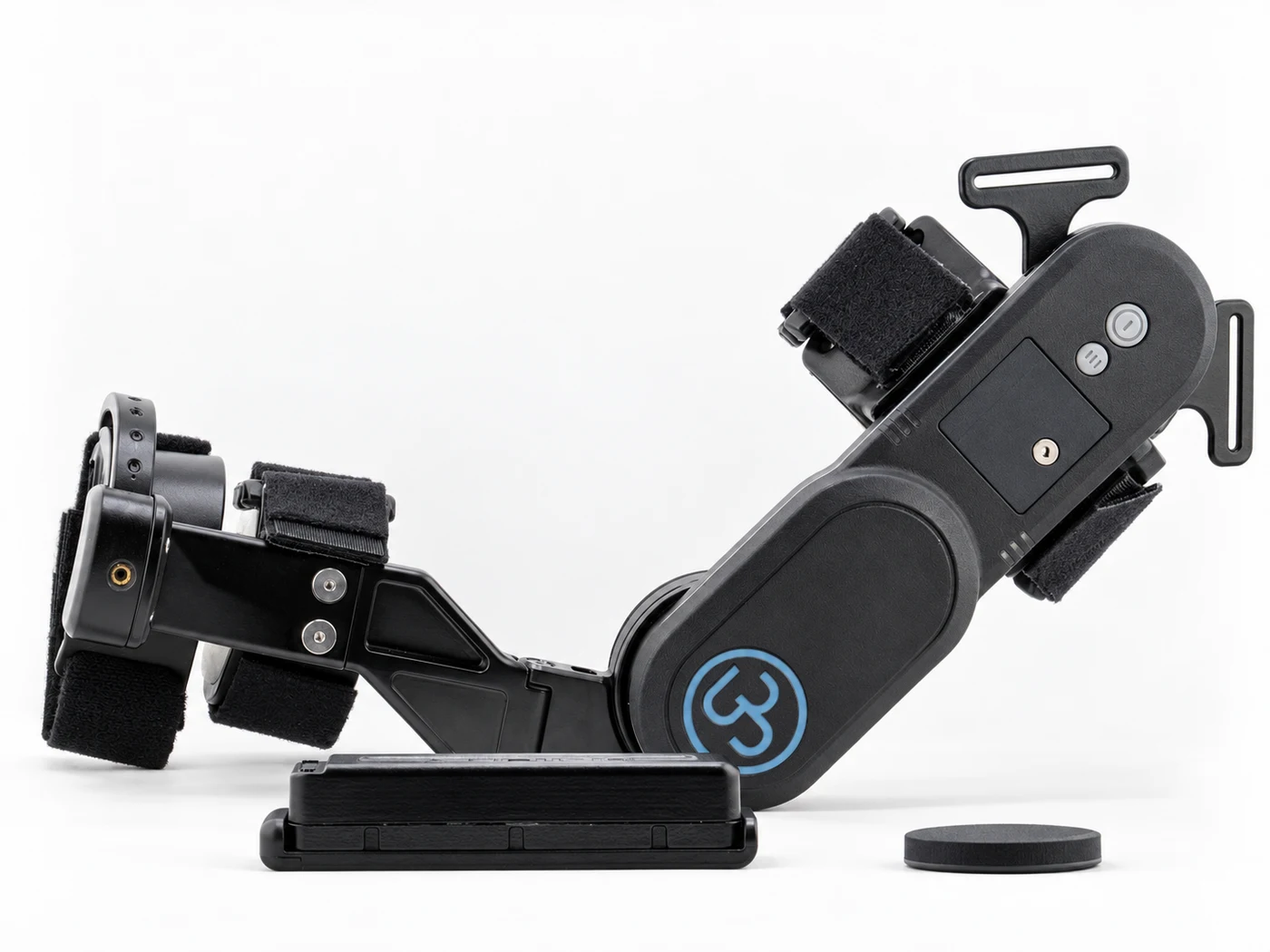
ONE INTEGRATED BRACE SYSTEM
The brace, battery, and surface-EMG sensor form part of the integrated system. Your evaluation considers both the physical fit and your ability to produce a usable control signal.
Contact the Ubility™ team03 / CONDITIONS TO DISCUSS WITH YOUR CLINICIAN
Patients with arm paralysis associated with ALS, stroke, or spinal cord injury may contact Ubility™ about an evaluation. A usable muscle signal, an appropriate physical fit, and individual clinical assessment are required; a diagnosis alone does not establish suitability or guarantee benefit.
For a person with ALS and severe arm weakness or paralysis, the evaluation question is whether a remaining voluntary muscle signal can provide usable control and whether the overall setup is appropriate.
Clinical review should consider current function, fatigue, support needs, and whether changing needs require reassessment.
For a person with arm weakness or paralysis after stroke, evaluation focuses on the available control signal, the affected arm’s movement limitations, and the activities the patient wants to work toward.
The team assesses the person’s ability to use the control method and tolerate the fitted brace rather than relying on the diagnosis alone.
For a person with spinal cord injury, including a wheelchair user with complete arm paralysis, evaluation can consider retained voluntary muscle activity outside the affected arm.
Signal control, seated positioning, arm support, fit, and the overall clinical picture determine whether a trial is appropriate.
04 / PRELIMINARY EXPERIENCE
Dr. Ajay Seth reports that preliminary UbiliFlex™ work included a patient with ALS using neck and facial muscle activity as control inputs.
This is an early observation reported by the developer, not evidence of effectiveness across patients with ALS. Study methods, participant numbers, outcomes, and safety findings are not presented here. Alternative control sites require individual assessment.
05 / BEFORE A PATIENT-SPECIFIC BUILD
A usable muscle signal is only one part of the decision. Your clinical team evaluates the complete picture before proceeding.
Discuss the patient’s condition, arm function, everyday priorities, and clinical factors relevant to a powered brace.
Identify a potentially suitable muscle site and assess detection, intentional activation and relaxation, repeatability, fatigue, and unintended signals.
Review available arm motion, comfort, skin contact, alignment, support, and the space needed for the device and the intended activity.
Consider how the patient will learn the control method, how the brace will be put on and removed, and what caregiver or clinical support is needed.
06 / THE PATIENT-SPECIFIC FABRICATION JOURNEY
The custom-fabrication pathway begins after clinical and signal assessment supports proceeding. This flowchart explains the build process; it is not an eligibility test or a promise of delivery.
Document the individual’s needs and the clinical decision to proceed.
Capture the patient-specific anatomical inputs.
Review and refine the model for custom design.
Determine the geometry and clearance needed for the individual interfaces, liner, and assembly.
Shape the patient-contact interfaces for the individual arm.
3D print cuff shells and fabricate the custom connecting parts.
Finish the components, make the patient-sized liners, and assemble with the powered hardware.
Set up the assembled brace and the assessed control signal for the patient.
Complete the required checks and guided training before delivery, where appropriate.
START WITH YOUR QUESTIONS
Ask your clinician whether powered arm assistance and an alternative muscle-control site are worth evaluating for your situation. This page is general information, not a diagnosis or an individual eligibility decision.
UbiliFlex™ is available now. Contact info@ubility.inc to learn about candidate evaluation. Results, insurance coverage, and suitability are not guaranteed; use must follow the applicable device instructions and clinical assessment.
Email info@ubility.incPlease start with a general inquiry. Do not email medical records or sensitive health details; ask the team how to share any required information securely.