The design question
How can the brace’s geometry and connections account for the patient’s arm alignment as part of a powered system?

 ™
Ask about candidacy
™
Ask about candidacy
ANATOMY MEETS ENGINEERING
UbiliFlex™ began with an orthopedic question: how can a powered brace better respect the alignment of the individual arm?
Explore the design story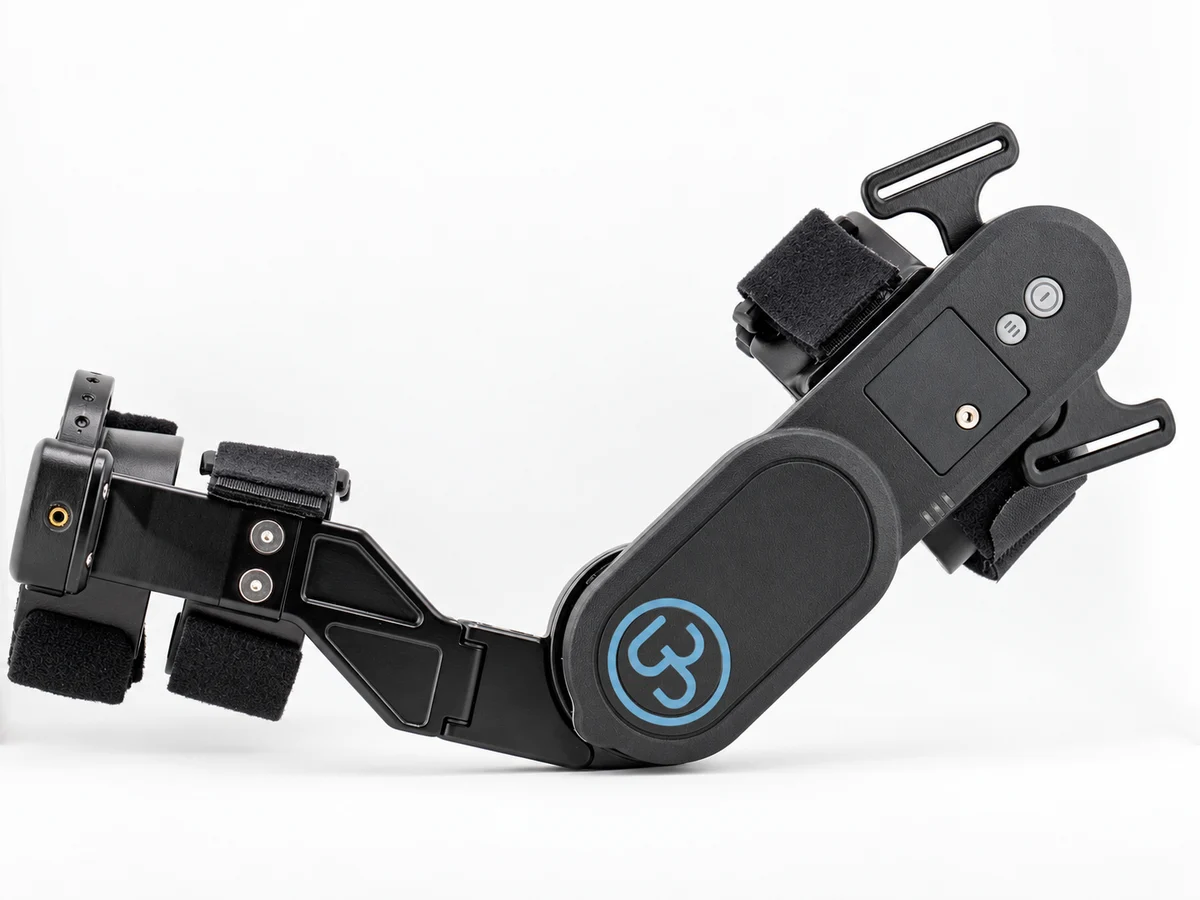
UBILIFLEX™ · AVAILABLE NOW
Patient-specific interfaces connect with the powered brace structure. Custom-fabricated cuffs, connecting geometry, and individual alignment bring orthopedic insight into the finished system.
Ask about an evaluation01 / THE ORTHOPEDIC INSIGHT
The concept behind UbiliFlex™
Dr. Ajay Seth
Not simply up and down.
Movement designed around the person.
Dr. Ajay Seth developed the concept of incorporating the elbow’s carrying angle into the brace design. His starting point was the patient’s anatomy, rather than a mechanism considered in isolation.
That insight shaped the design challenge: bring powered assistance and patient-specific alignment together, with the aim of making supported arm movement feel more natural.
The question was not only how to move the arm. It was how to develop a brace that works with the individual arm.
03 / THE ENGINEERING COLLABORATION
Orthopedic insight defined the challenge. Collaboration with engineers helped translate that insight into the physical brace.
Bring the carrying-angle idea and the patient’s alignment needs into the engineering discussion from the outset.
Develop the relationships between the cuffs, lower arm bar, connections, and powered mechanism around the patient-specific design.
Combine custom-fabricated interfaces and connecting parts with standard powered components as one assembled orthosis.
Connect the design to individual fitting, alignment, setup, and guided training. The patient remains the reference point throughout.
THE PURPOSE BEHIND THE PROCESS
Helping people regain some independence is the purpose behind our work. UbiliFlex™ is available now, with powered assistance, custom-fabricated interfaces, and an individual fitting process.
Natural-feeling movement is a design aim, not a guaranteed outcome. Suitability and the patient’s experience require individual clinical evaluation.